What Michael Horn Gets Right About the Future of Microschools
Education thought leader Michael B. Horn believes small schools can unlock innovation, personalization, and deeper human connection.
In 2022, education thought leader Michael B. Horn wrote an article with a clear message: “Cut the Regulations and Allow Microschools to Flourish.”
At the time, many people still saw microschools and learning pods primarily as responses to the pandemic. Michael saw something more enduring.
He believed these small learning environments could offer families greater personalization, give educators more freedom to innovate, and expand access to new forms of education.
Four years later, the microschool movement is no longer a temporary experiment.
Educators across the country are creating small schools around the needs of their communities. Families are actively seeking tailored and personalized options. Education Savings Accounts and other school-choice programs are making alternatives accessible to more children.
And Michael believes the opportunity is still unfolding.
In a recent conversation with Changemaker Education CEO David K. Richards, Michael shared:
“I think there's never been a better time to be an education entrepreneur starting schools than right now.”
For the educators, parents, and community leaders who have been imagining a different kind of school, this moment matters.
Small Communities Create Room for Something Different
The power of a microschool is that a smaller learning environment changes what becomes possible.
Educators can build genuine relationships with every child. They can understand how each student learns, what motivates them, where they are struggling, and what helps them regain confidence after a setback.
Families and educators can communicate more closely. New ideas can be tried, evaluated, and adjusted without traveling through layers of approval. Learning can respond to the children who are actually in the room.
As Michael explained:
“In a trusting community, there are deeper relationships with the adults and the kids to really understand what they need to unlock growth and progress.”
Trust creates the conditions for children to take healthy risks, ask questions, make mistakes, and discover their own abilities.
It also creates the conditions for educators to do the kind of work they entered the profession hoping to do.
The Right Answer for the Child
One of the most important ideas in David and Michael’s conversation emerged during their discussion of technology and screen time.
Some microschools are exploring AI-supported learning, adaptive tools, and new approaches to assessment. Others are prioritizing nature, hands-on experiences, and as little screen time as possible.
Michael resisted prescribing one universal approach:
“I don’t want a one-size-fits-all answer on that question. I want the right answer for the kid.”
We agree. The right learning environment may look different for a child who thrives through performance, a child who wants to build and create, a child who feels most alive outdoors, or a child who needs a quieter and more nurturing community.
This is why Changemaker Education’s Founders do not all build the same school.
One may create a performing arts microschool. Another may envision an AI-focused learning lab, an outdoor school, a program centered on entrepreneurship, or simply a deeply supportive environment for children who have felt overlooked elsewhere.
Each school has its own identity because every Founder and every community brings different gifts, challenges, and possibilities.
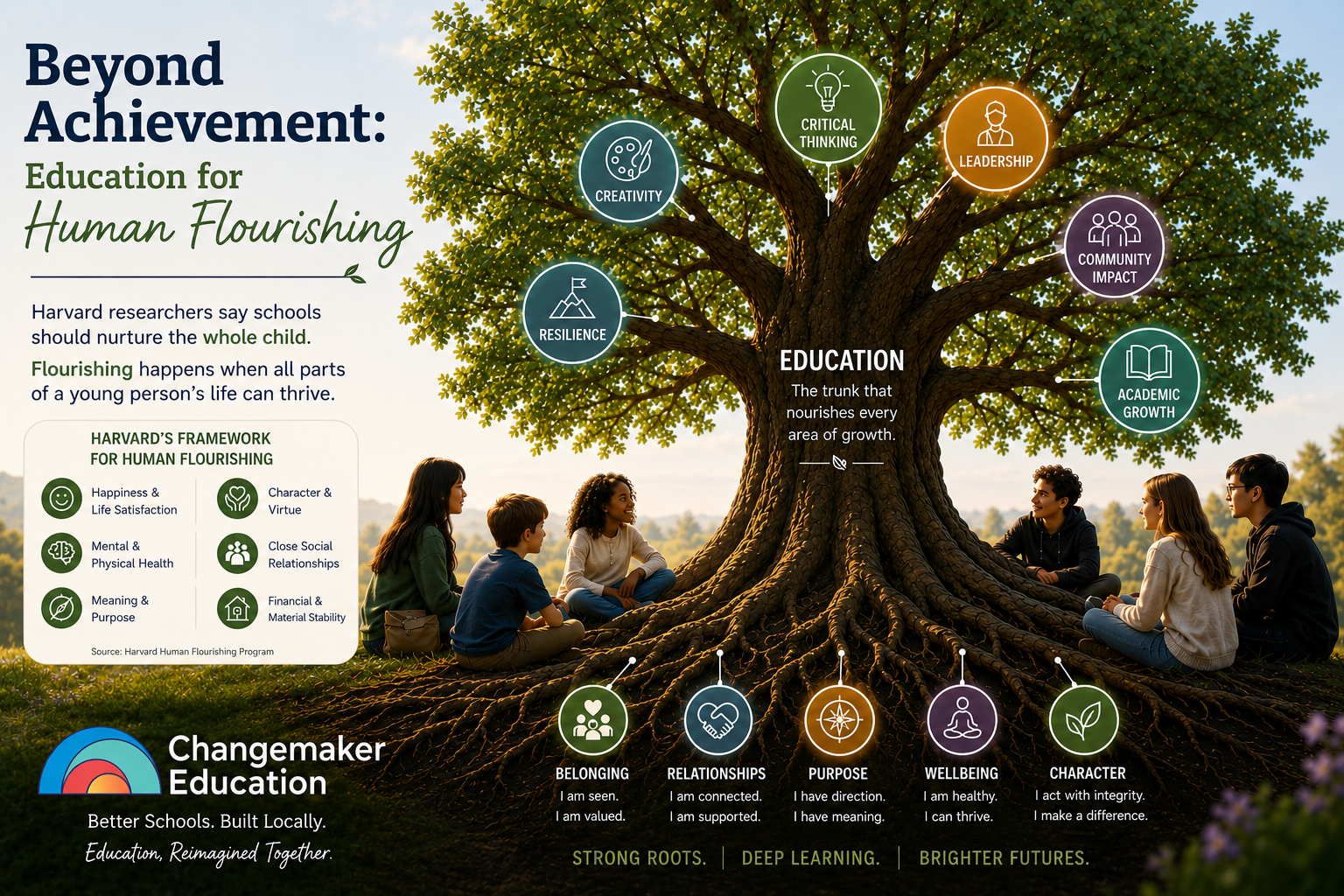
Across the Changemaker network, those schools are connected by our shared values of love, autonomy, community, creativity, and equity, along with our commitment to Mind, Body, and Soul development.
Within that foundation, Founders are given the ownership and autonomy to build the school they believe their students need.
Technology Should Support the Humans
Artificial intelligence will shape the world our children enter. Schools have a responsibility to help students understand and use it thoughtfully.
AI may also help small schools accomplish things that previously required the resources of much larger institutions.
AI can help educators tailor lessons, identify gaps faster, and provide meaningful insights on learner progress. All great for academic efficiency!
But Michael offered an essential guardrail:
“Technology is a support. It’s not the lead.”
People lead.
The educator who knows the child leads. The relationships within the learning community lead. The microschool’s purpose and values lead.
Technology should help educators become more responsive and effective. It should create more opportunities for meaningful learning and human connection.
Inside a small, trusting community, Founders can make thoughtful choices about when technology adds value, when it becomes a distraction, and what balance is right for each child.
Assessment Can Become Part of Learning
Michael also shared a powerful vision for the future of assessment.
Traditional assessments often tell educators and families what a student understood after a unit, semester, or school year has already ended. The information may arrive too late to meaningfully support the learning process.
With thoughtfully designed AI tools, feedback could become more immediate and useful. Educators might gain insight into how students respond to setbacks, apply critical-thinking skills, develop agency, or engage with challenging material.
Michael summarized the opportunity memorably:
“Assessment isn’t an autopsy, but it’s actually something that’s helping you.”
In a microschool, assessment can become part of an ongoing conversation.
What is this child understanding?
What support would help?
What should we try next?
Where are we seeing growth that a standardized score may not capture?
That kind of feedback helps educators respond while learning is still happening.
The beauty of a microschool is that educators have the freedom to change up lessons for each student based on that data immediately. No wait. No red tape. No permission required.
Scale the Principles, Not an Identical School
As the microschool movement grows, networks will play an important role.
Founders need coaching, systems, operational guidance, enrollment support, resources, and a community of people who understand what it takes to build a school and keep it running.
Yet growth does not have to mean creating an identical experience in every location.
Michael reflected on a lesson from the charter-school movement:
“You don’t scale by taking the KIPP model and copying and pasting it a billion times. I think you take principles.”
Strong principles can travel.
Mastery-based learning can travel. Whole-human development can travel. A commitment to meaningful relationships, student agency, community, and belonging can travel.
How those principles come to life should reflect the Founder, the children, and the local community.
This is central to Changemaker Education’s model.
We provide the roadmap, infrastructure, coaching, resources, partnerships, and community that help a Founder build a sustainable school. The Founder retains the autonomy to create a learning environment that reflects their own vision and genius.
The result is a connected network filled with distinctive, locally led schools.
A Future Filled With Possibility
Michael imagines an education landscape with several larger microschool networks and many locally created schools, much like a community has the one-of-a-kind, boutique, neighborhood shop everyone loves.
He hopes that for every centrally standardized microschool run by Primer or Alpha School, "there are also three local educators that have their different versions of microschooling.”
We share that vision and actively support it.
The future of education should have room for many versions of microschools.
It should include schools built by educators who have spent years imagining what they would create if they had greater freedom. It should include parents, entrepreneurs, nonprofit leaders, and community builders who recognize an unmet need and feel called to respond.
Most importantly, it should include far more places where children are known, loved, challenged, supported, and given the opportunity to discover who they are and who they want to become.
Your Fall 2027 School Starts Now
Changemaker Education’s Fall Founder Cohort is officially underway.
An inspiring group of future microschool Founders has already begun the journey. They are clarifying their visions, learning from one another, and laying the foundation for the schools they will bring to life.
These are the people who will encourage you, challenge you, celebrate your progress, and very likely become fast friends.
And there is still time to join them.
If you want to open a microschool for Fall 2027, now is the time to begin.
Building a trusted, sustainable school takes thoughtful preparation. You need time to shape your learning model, understand your community, create a sustainable financial plan, establish your operations, and build relationships with prospective families.
You do not need to have every detail figured out before you join us. You simply need a vision for what could be possible, a willingness to learn, and the courage to take your next step.
Explore the Changemaker Pathway Programs and join the Fall Founder Cohort.
Your future students are waiting for the school only you can create.
%20(9).png)


Join the Education Revolution
Be part of a transformative movement that empowers learners and reshapes education for the better.
