The Next Evolution of Education Isn’t Just Structural — It’s Energetic
The next evolution of education is about how learning feels. Jess Steele, Changemaker Founder of The Resonance Lab, explores this transformation.
%20(9).png)
Co-Created with: Jessica Steele, Founder of The Resonance Lab, a microschool launching in Cincinnati, Ohio
Across the country, something powerful is happening in education. Not just a shift in models, but a shift in how we understand what it means to learn, lead, and grow. From microschools to amplified homeschool environments, such as co-ops and hybrid programs, there’s a clear shift toward more flexible, personalized models of education.
And yet, even with all of this innovation, something still feels off for many students, educators, and families alike.
At Changemaker Education, we see this same pattern across the microschools we support. Founders aren’t just rethinking structure, they’re rethinking the human experience of learning itself.
For Jess Steele, founder of The Resonance Lab in Cincinnati, Ohio, that feeling became the inception of something brand-new. After years in educational leadership, she began to recognize that what wasn’t working in education wasn’t just structural or even cultural: it was energetic. In other words, it wasn’t just what schools were doing, it was how people were experiencing them.
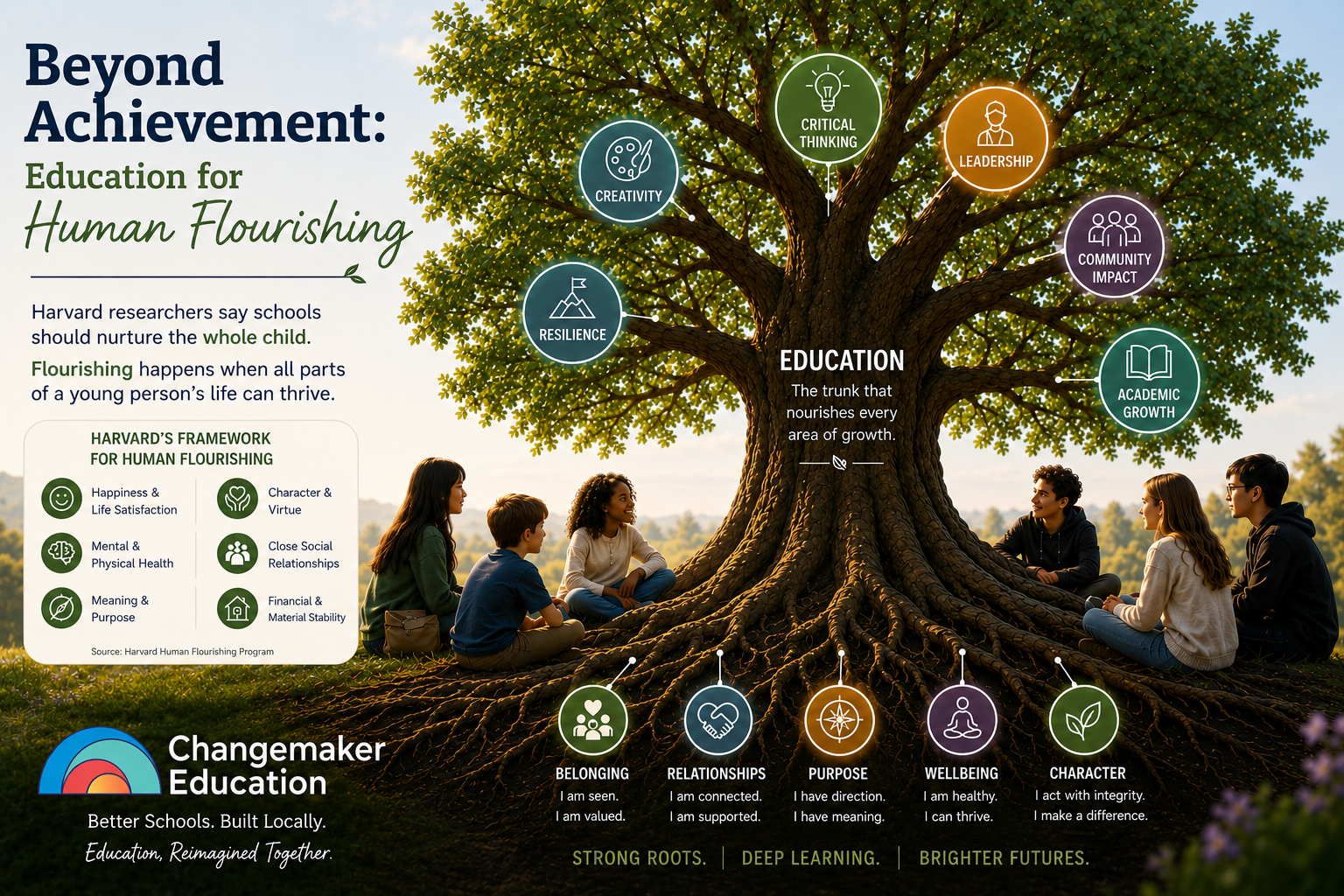
Her work now centers on creating learning environments rooted in alignment, self-awareness, and authentic leadership - spaces where students are not only challenged academically, but supported as whole humans.
In the conversation below, Jess shares with Joy Meserve, COO of Changemaker Education, what led her to this work, why she believes education is at a turning point, and how The Resonance Lab is designed to support the exploration and recognition of one’s human potential based on their own unique energetic design.
------------------------
Joy: Before The Resonance Lab existed, what were you noticing—or feeling—in education that you couldn’t ignore anymore?
Jess: I moved back to Cincinnati, Ohio, after a lifelong career in education in Phoenix, Arizona, in 2023. After a short stint supporting schools in a more operational capacity, I decided that my true life purpose requires more intimate involvement in the education space. However, I quickly realized that the same systems and structures that led to burnout culture and a lack of personal and professional thriving in Phoenix were alive and well in the Midwest, too. After an intensive search for my next school home, I realized that what I was seeking simply doesn’t exist in the education space just yet.
We talk a lot about innovation in education; however, in many systems, the changes still fail to honor the whole child. We talk about whole-child education; however, we adopt one-size-fits-all programming that doesn’t distinguish between our students’ unique needs. We create courses and pathways that engage students based on their interests and future goals, yet we push them through these pathways using the same bell schedules or curricula structures we have been using since the 1900s. Innovation still looks the same for all students. It just has fancy verbiage wrapped around it.
There’s a level of rigidity (whether it’s pacing, programming, or resources) that makes it incredibly difficult in traditional classrooms to respond to the humans right in front of you. Even when educators want to do something different, state-level testing requirements, district mandates, and other achievement-based identifiers keep innovation endeavors prohibitive at best and a repetition of old, outdated patterns at best.
I want to create a school where the entire community’s humanity is honored. Communities that were initially meant to be built in communion and connection with people have started to feel like they are operating around them instead. That is the intention and the heart behind The Resonance Lab. It’s education reimagined by honoring the humanity of the whole community, not as a one-time event, but as an intentional, co-created system that is revised and refined by human-centered data every single day.
Joy: A lot of people talk about what’s “broken” in education. From your perspective, what’s actually not working—and why do you believe it goes deeper than structure?
Jess: I think what’s “broken” in education is not one particular system, strategy, or approach. What’s broken is that the system was designed to meet the needs of a student body and future workforce that looks strikingly different today than it did upon the creation of large, public school systems.
The world has evolved, but our educational system has undergone little more than minor structural changes since the 1950s. What used to be “good enough” to serve the majority hasn’t shifted in conjunction with the rest of the world. We’ve taken a collective approach to learning, where we aim to serve the most students efficiently, and in doing so, we’ve lost sight of the individual learner.
We purchase one-size-fits-all curriculum and then differentiate within it — often grouping students into high, medium, and low—rather than truly responding to specific skills, needs, and strengths. It creates the appearance of personalization, but it’s still rooted in standardization.
At the same time, we’ve built a narrative around what students are lacking — how far behind they are, especially post-COVID—while continuing to teach toward systems and assessments that haven’t evolved alongside the world our students are actually entering.
And underneath all of this, there’s a deeper issue: We’ve prioritized academic performance over human development. Students are often seen as learners first, and humans second, without enough space to explore identity, perspective, agency, and impact. These are the very concepts that shape how they move through the world.
When you combine that with rigid systems, limited flexibility, and constant pressure, the effects start to show: the people within our systems, students, staff, and parents alike, burn out, experience heightened anxiety, struggle with inattention and hyperactivity, and lose what fuels our souls as energetic beings: time for movement, experiencing nature, and unstructured exploration and play.
Joy: You’ve said the next evolution of education isn’t just structural, it’s energetic. What does that actually mean in practice?
Jess: When I say the next evolution of education is energetic, I’m not talking about something abstract. I’m talking about how we maximize our own unique operating systems to thrive both personally and professionally in this ever-changing world.
We spend a lot of time focusing on structure in education, such as curriculum, schedules, and systems. And those things matter. In fact, I’ve been highly focused on the structural elements that will reinforce the energy and sustainability of The Resonance Lab in these formative months as a founder. However, structure alone doesn’t determine how our students, families, and staff will experience education. Energy is a primary component of an embodied educational experience.
To put this in clear language, you can have the most well-designed, standards-aligned lesson in the world, but if a student is dysregulated, disconnected, or feels unsafe in the environment, high levels of learning cannot occur. If a teacher doesn’t feel valued or safe to express their ideas and beliefs, they won’t have the capacity to perform according to their strengths.
When we consider the energetic foundation on which our systems are built, something really beautiful starts to shift. We prioritize regulation before redirection. Connection before correction. Being before doing.
When we support our students in understanding themselves, not just as learners, but as humans, their level of self-awareness increases, and everything changes. They are no longer completing tasks, but engaging intentionally with the learning and growing process.
Additionally, adults perform differently in this energetically aligned space. Since we know that like energy attracts like energy, when our environments mirror the energy of aligned adults leading it, the entire communal energy shifts, and opportunities to thrive increase.
Joy: What do you hope shifts in education as more models like this begin to emerge?
Jess: I have such high hopes for the future of education as more models like this begin to emerge. I hope we begin to shift from designing systems for efficiency to designing experiences for alignment.
For so long, education has been built around what’s measurable, scalable, and manageable. And while each of these things has its place, they’ve also led us away from addressing the needs of our very human, very individual learners. I hope that in the future, we move away from standardized outcomes of success and toward a more expansive understanding of what it means for a student to thrive in their mind, body, and spirit. I hope we begin to value self-awareness, emotional regulation, and identity development as essential parts of the learning process and not just something supplemental to academic success.
Ultimately, I hope we create spaces where students don’t learn how to hack a system and actually embrace what it means to develop as a human with limitless potential, leading themselves with clarity, confidence, and ease into a purpose-driven future.
Joy: As you bring The Resonance Lab to life, what do you hope families and students experience that they may not have experienced before?
Jess: I hope they experience what it feels like to be truly seen, not just for what they produce, but for who they are.
For students, that looks like waking up and feeling excited to go to school because they know they belong there. They’re not trying to fit into a mold or keep up with a pace that doesn’t match their energy or skillset. They’re learning in a way that honors how they think, how they move, how they process, and how they connect.
For families, I hope it feels like exhaling. Like they don’t have to fight so hard to advocate for their child to be understood. There’s a level of trust that develops when you know your child is in an environment where their humanity is just as important as their academic growth.
And for the community as a whole, I hope it feels like a return to connection, to presence, to what learning can actually feel like when it honors our whole humanity.
And for me? Well, it already feels like the most devoted act of love.
------------------------
The future of education won’t be built by systems alone.
It will be built by founders willing to reimagine what school feels like at every level.
If you’re feeling this shift too, you’re not alone.
And you don’t have to build it alone either. Join us!


Join the Education Revolution
Be part of a transformative movement that empowers learners and reshapes education for the better.
