Education’s Costly Productivity Trap, And How Microschools Are Breaking Free
Microschools restore the rhythms of learning: curiosity, rest, play, and community - replacing the productivity-driven model with a human-centered approach.

American schools have become efficiency machines. Schedules have been optimized down to the minute, eliminating "wasted" time and structuring every moment around measurable outcomes.
All for the greater good?
In our rush to maximize productivity, we've quietly removed the essential: the rhythm of human learning itself. We've lost the:
- Pauses between effort
- Rituals that build belonging
- Unstructured moments where children discover who they are
Losing the nostalgia that comes from these things is damaging enough. But the cost extends into neurological development, emotional regulation, and long-term learning.
The Documented Decline of Childhood Rhythm
Since the 1980s, American students have experienced a significant decline in unstructured time as educational priorities shifted toward increased "schoolification."
According to the American Academy of Pediatrics, many school districts have reduced or eliminated recess to accommodate higher academic standards, with administrators often viewing unstructured play as "wasteful" time that would be better spent on additional test preparation. The rise of standardized testing has fundamentally altered the structure of the school day.
Such data reveals a troubling pattern: as schools have intensified academic demands, they've simultaneously removed the developmental supports children need to meet those demands.
Research published in the journal Pediatrics indicates that recess offers essential cognitive, social, emotional, and physical developmental benefits that structured classroom instruction cannot duplicate. Despite its critical role, recess has often been viewed as expendable in schools, sometimes reduced or eliminated in efforts to boost test scores.
What We've Surrendered
The loss isn't abstract. Walk into many public schools today and you'll find concrete evidence of what's been removed:
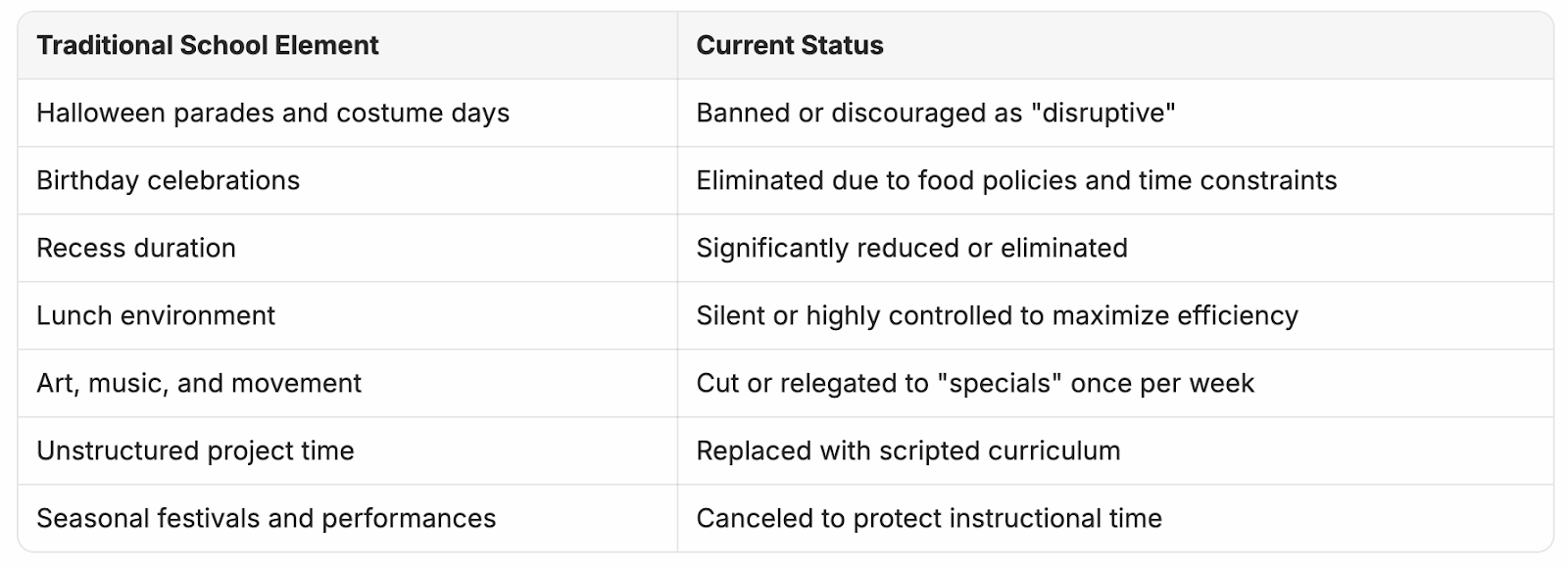
These replacements represent a fundamental shift in what we believe childhood is for.
Silent lunches, where children eat without speaking to preserve order, are becoming increasingly normalized in schools across the country. And with the little recess time that is left, it is withheld as punishment or eliminated entirely when students fall behind academically, despite evidence that physical activity improves focus and academic performance.
“We’ve optimized schools for productivity, not children. Microschools return to what actually works: curiosity, community, and the developmental rhythms that make learning meaningful and sustainable.” — David K. Richards, Founder and CEO of Changemaker Education
The American Academy of Pediatrics explicitly warns against this practice, noting that recess should never be withheld for punitive or academic reasons.
Think about the irony here. We've removed the very experiences that make learning sustainable, memorable, and meaningful.
Why Humans Need Rhythm, Not Just Rigor
We know from our own educational experiences or those of our classmates, friends, kids, etc. that human learning doesn't happen in a straight line. It requires alternating periods of effort and integration, focus and release.
Neuroscience confirms that rhythm matters. The brain consolidates learning during rest, not just during instruction. Memory formation, creative problem-solving, and emotional processing all depend on downtime.
When we eliminate pauses, learning isn’t accelerating; it’s being interrupted.
The Role of Rituals and Celebration
Rituals serve a critical developmental function. Seasonal celebrations, weekly traditions, and daily routines create psychological anchoring points. They build community identity, mark the passage of time, and give children a sense of belonging that transcends academic performance.
Research indicates that predictable routines and rituals in child development are associated with reduced anxiety, increased safety feelings, and improved learning readiness. Studies have shown that consistent routines are linked to lower cortisol levels, suggesting better emotional regulation and reduced stress.
Celebration also reinforces meaning. When schools honor milestones, recognize growth, and create space for joy, they communicate that learning is about more than compliance. They signal that childhood itself has value.
The corporate world has already learned this lesson. Most of us are familiar with the burnout crisis of the past decade, where companies rediscovered the importance of rest, celebration, and human-centered rhythms.
Education, however, continues to lag behind, and is still operating under the assumption that more time on task equals better outcomes.
What Microschools Can Restore
This is just another example of Microschools not simply being smaller versions of traditional schools. Microschools represent an entirely different philosophy that recognizes rhythm, rest, and celebration as foundational rather than optional.
Seasonal Rituals and Community Celebrations
These become central to the learning experience. Harvest festivals, solstice gatherings, student-led performances, and family traditions create shared memories and cultural identity. All of these things form the context that makes learning matter.
Flexible Schedules with Long Blocks
Instead of fragmenting the day into rigid periods, microschools can structure time around natural rhythms. Specifically, long mornings for focused work, extended afternoons for exploration, spacious transitions that honor the pace of childhood. Research on unstructured play shows that extended periods of free time allow children to develop the executive function skills that fragmented schedules cannot cultivate.
Slower Pacing and Deeper Integration
When a concept can be explored over days or weeks rather than rushed through in a single lesson, children develop genuine understanding rather than surface-level familiarity. The pressure to "cover material" gives way to the freedom to go deep.
Child Autonomy and Spontaneity
When a child's curiosity leads in an unexpected direction, the schedule can flex. When energy is low, rest is honored. When excitement is high, momentum follows. This responsiveness to children's actual needs creates conditions for authentic learning.
Unstructured Project Time
Self-directed exploration builds intrinsic motivation. Children learn to manage their own time, pursue their own questions, and develop the executive function skills that scripted schedules can never teach. Free play fosters social skills, stress regulation, creativity, and cognitive growth in ways that structured activities cannot replicate.
“Microschools aren’t escaping rigor. They’re restoring the rhythm of human learning. When children have space to breathe, explore, and belong, they don’t just perform better… they thrive.” — Joy Meserve, COO, Changemaker Education
A Different Question
With all of this, the productivity culture in education is continually asking “How can we maximize learning outcomes?”
But perhaps we've been asking the wrong question.
- What if rest and celebration weren't bonuses to be earned after the "real work" is done, but essential pillars of human development?
- What if the pauses between effort are where integration happens?
- What if joy isn't a distraction from learning, but its deepest purpose?
Microschools offer a chance to rebuild education around a more complete understanding of how humans actually learn and grow.
- Not through relentless optimization, but through rhythm.
- Not through constant measurement, but through meaning.
- Not through productivity alone, but through the full experience of childhood
The question isn't whether we can afford to prioritize these things. The question is: what kind of childhood do we want our children to remember?
%20(9).png)

Join the Education Revolution
Be part of a transformative movement that empowers learners and reshapes education for the better.
